Who Will Actually Run Asia's New Fabs?
Capital is flooding into semiconductor capacity across Japan, India, Malaysia, and beyond.

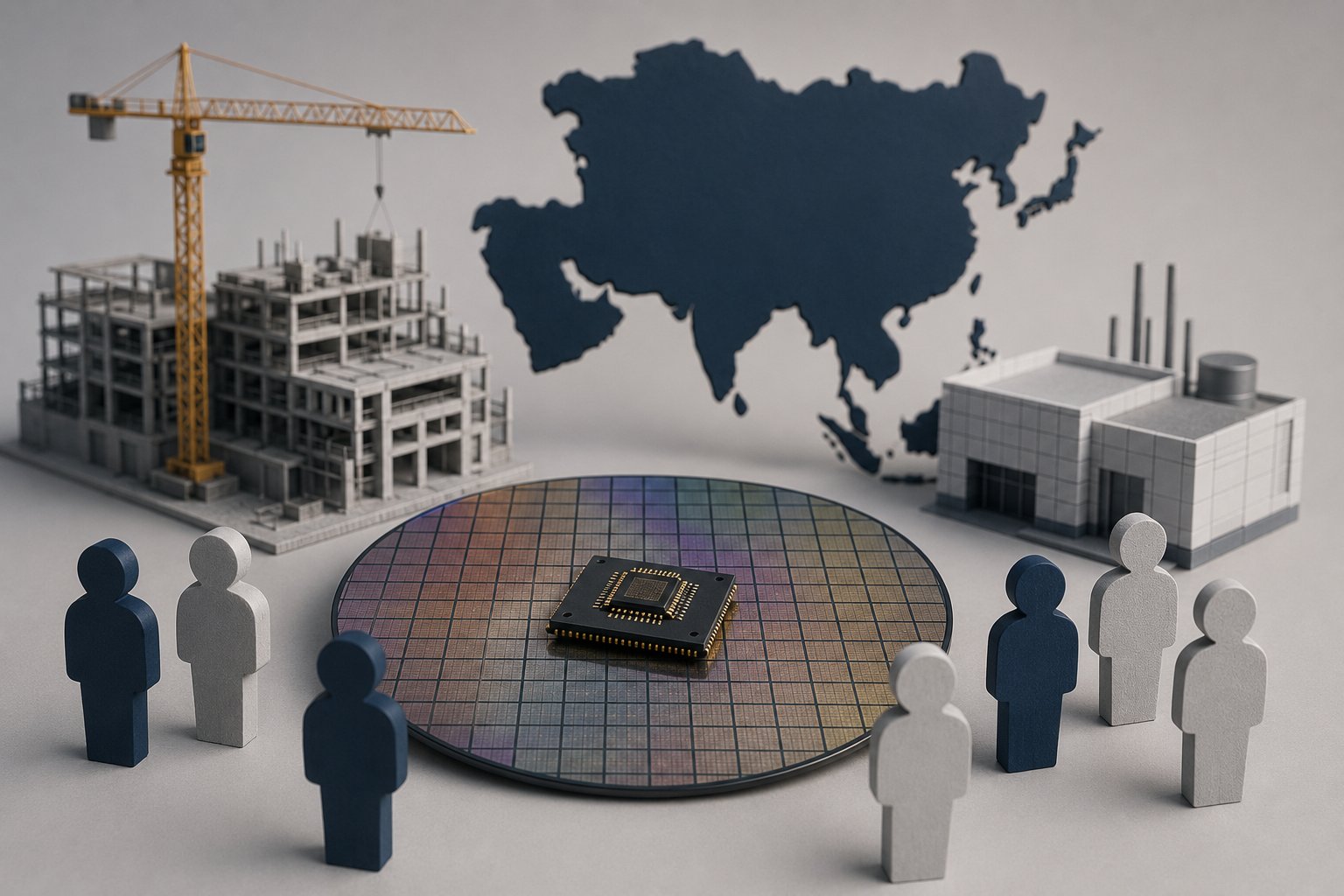
Capital is flooding into semiconductor capacity across Japan, India, Malaysia, and beyond.
The semiconductor industry has a capital problem that isn't about capital at all.
Over the past eighteen months, I've sat across the table from board directors in Tokyo, Mumbai, Singapore, and Seoul—all asking variations of the same question: "Where do we find the person who can actually make this work?"
They're not talking about funding. Between government subsidies and corporate balance sheets, there's more money chasing semiconductor capacity than at any point in history. SEMI projects roughly $400 billion in wafer-fab equipment spending between 2025 and 2027, with China, South Korea, Taiwan, and Japan leading the charge. Across Japan, India, Singapore, Malaysia, and Korea alone, over twenty new fabs are in various stages of permitting, construction, and ramp-up through 2027.
The problem is simpler and more intractable: there are perhaps 200 to 300 executives globally who have actually built or scaled a large semiconductor fab from the ground up. And right now, dozens of projects across three continents are competing for that same finite pool of talent.
This isn't a hiring challenge. It's a structural leadership deficit that will determine which of these billion-dollar bets succeed and which become expensive monuments to ambition.
Let me walk you through what's actually happening on the ground, because the numbers alone don't capture the human complexity underneath.
Japan's semiconductor revival is the most strategically coherent national effort I've observed in two decades of executive search work.
TSMC's Kumamoto operation—formally Japan Advanced Semiconductor Manufacturing, or JASM—represents a masterclass in ecosystem building. Phase 1 is already in volume production, running specialty technology nodes that feed Japan's automotive and industrial giants. Sony, Toyota, and Denso aren't just customers; they're equity partners with skin in the game.
Phase 2 is where things get interesting. Originally planned as a $12.2 billion investment targeting 6 to 12 nanometer production with a late 2027 start, reports now indicate TSMC is reconsidering the entire node strategy. The potential shift to 3 nanometer—or even discussions around 2 nanometer—would push the investment toward $17 billion and extend timelines into 2028 or 2029.
This isn't indecision. It's strategic recalibration driven by AI demand that's rewriting every capacity plan in the industry.
But here's what the press releases don't tell you: this node upgrade creates a cascading leadership challenge. The talent requirements for running a 6 nanometer fab versus a 3 nanometer fab are categorically different. Process integration complexity increases exponentially. Yield engineering becomes a black art practiced by a handful of experts worldwide. Equipment engineering for EUV lithography at advanced nodes requires specialists who can be counted in the hundreds, not thousands.
TSMC Kumamoto is hiring aggressively—fab operations leaders, equipment engineering heads, process integration specialists. The talent pool they're drawing from is primarily Taiwanese experts seconded from TSMC's home operations, supplemented by local Japanese engineers and, increasingly, returning diaspora who built their careers abroad.
The Japanese government understands this constraint. Subsidies explicitly include workforce development funding, and Kumamoto Prefecture has partnered with local universities to accelerate engineering pipelines. But you can't compress a decade of fab experience into a two-year training program.
Then there's Rapidus.
If TSMC Kumamoto is a methodical expansion of proven capability, Rapidus is a moonshot. This government-backed consortium is targeting 2 nanometer production by 2027—technology that doesn't yet exist in volume manufacturing anywhere in the world.
In February 2026, Rapidus secured an additional ¥267.6 billion (roughly $1.7 billion) from a consortium of 32 private firms including Sony, Toyota, and SoftBank, on top of massive government backing that could exceed one trillion yen through 2027. The pilot line is operational. Transistor demonstrations have been successful. IBM's technology partnership provides crucial process knowledge.
But CEO Atsuyoshi Koike faces a leadership challenge unlike any other in the industry: building a world-class fab team from scratch, without the institutional knowledge that companies like TSMC and Samsung have accumulated over decades. Rapidus isn't just competing for talent; it's competing with the promise of being part of something unprecedented.
I've spoken with semiconductor executives who've turned down lucrative offers from established players to join Rapidus. The pitch isn't compensation—it's legacy. How often do you get to build a national semiconductor champion from the ground up?
India's semiconductor ambitions would have seemed fantastical five years ago. Today, they're backed by real capital and real construction.
The Tata Electronics-PSMC joint venture in Dholera, Gujarat represents an $11 billion bet that India can compress decades of semiconductor ecosystem development into years. The 300mm wafer fab is targeting 28 nanometer as its starting node, with initial capacity of 50,000 wafers per month focused on power management ICs, display drivers, microcontrollers, and logic for automotive and AI applications.
Construction is underway. Commercial production was originally targeted for mid-2025, but realistic timelines now point to late 2026 or early 2027. This isn't failure—it's the normal friction of building something this complex in a country without existing fab infrastructure.
The leadership architecture tells the story of how India is approaching this challenge.
At the top, N. Chandrasekaran now chairs Tata Electronics, signaling the group's strategic commitment. Randhir Thakur, who ran Intel's foundry business, serves as CEO and Managing Director. And in April 2025, Tata appointed KC Ang as President and Head of Tata Semiconductor Manufacturing—a hire that sent a clear message to the industry.
Ang spent over 30 years in foundry operations, most recently as President of GlobalFoundries' Asia operations and Chairman of their China business. He's built fabs. He's scaled capacity. He knows where the bodies are buried.
Below the C-suite, the sourcing strategy is pragmatic: TSMC alumni, returning Indian diaspora from global fabs, and structured training programs sending cohorts of 50 to 75 Tata employees to PSMC in Taiwan for hands-on experience across equipment, yield, process, and quality disciplines.
Micron's Sanand facility represents a different model—leveraging the company's global assembly and test expertise for a greenfield ATMP operation. Phase 1 opened in February 2026, with commercial output ramping to tens of millions of chips this year and targeting hundreds of millions in 2027. At $2.75 billion in total investment (with significant government incentives), it's smaller than Tata-PSMC but arguably further along the execution curve.
The India Semiconductor Mission has now sanctioned 10 projects with cumulative investment exceeding $18 billion across Odisha, Punjab, Andhra Pradesh, Maharashtra, and Gujarat. Most are OSAT, specialty fabs, and ecosystem manufacturing rather than leading-edge logic. But they're real projects with real hiring needs.
The honest challenge for India: there is no domestic pool of fab leadership talent. The country is building from zero, which means every plant director, every quality head, every process integration leader must be imported—whether from Taiwan, Singapore, the United States, or the Indian diaspora abroad.
This isn't a criticism. It's a structural reality that India is addressing through a combination of attractive compensation, the appeal of building something genuinely new, and the pull of homecoming for engineers who've spent decades abroad.
Malaysia has been the world's OSAT hub for decades. What's changing is the recognition that backend operations—assembly, test, and increasingly advanced packaging—are no longer commodity activities.
The National Semiconductor Strategy, launched in 2024 with $5.9 billion in fiscal support, explicitly targets moving up the value chain. The goal isn't just more OSAT capacity; it's advanced packaging, IC design, and eventually more front-end manufacturing.
The investment momentum is real. Infineon is building a $7 billion silicon carbide fab in Kulim. Intel announced an additional $208 million in December 2025 for assembly and test expansion in Penang and Kulim, on top of a prior $7 billion advanced packaging plant that's now 99% complete and a decade-long commitment of RM30 billion. Amkor is investing $3.6 billion in packaging. Chipbond is putting $200 million into an advanced facility in Batu Kawan.
But I've also heard from recruiters and industry contacts that some expansion plans have slowed. Weak demand for older-node chips and tariff uncertainty have caused Intel, ASE, and other major packaging players to pause or reassess certain Malaysia projects. Advanced packaging for AI workloads is being prioritized in Taiwan, creating a more cyclical leadership market in Malaysia than in India or Japan.
Singapore remains the region's R&D and design leader, with over $23 billion in new projects including a Vanguard-NXP joint venture for a $7.8 billion power chip and silicon wafer facility targeting 2027 operations, plus GlobalFoundries' roughly $4 billion fab expansion.
Vietnam is the emerging story. With $23.5 billion in high-tech FDI in 2024 alone, the country is positioning itself as an assembly, test, and packaging alternative to China. Intel handles about 50% of its global packaging and test volume there. Samsung continues multi-billion dollar expansions plus a $220 million R&D center. Amkor is investing $1.6 billion in advanced packaging in Bac Ninh.
The talent implications are acute. Vietnam's market is projected to grow from $10 billion in 2025 to $16.5 billion by 2030. But the leadership pipeline for running these facilities is thin. Companies are importing Malaysian and Singaporean veterans, recruiting from Taiwan, and building training programs with local universities that will take years to produce results.
South Korea's position is unique: it's simultaneously a source of leadership talent for the world and a country desperately trying to retain that talent.
The K-Semiconductor Strategy targets roughly $450 billion in investment by 2030, with a fresh $7 billion government pledge through 2027 including $1.4 billion specifically for AI chips. Samsung and SK Hynix continue massive expansions at Pyeongtaek and elsewhere, focused on memory and high-bandwidth memory for AI workloads.
Korea is expected to reclaim the number two spot in global fab equipment spending by 2026. But the country's semiconductor leaders—people who've scaled DRAM production and built HBM capacity—are among the most sought-after executives in the world.
Every new fab in Japan, India, and the United States is effectively recruiting from Korea's talent pool. The compensation inflation I'm seeing for senior Korean semiconductor executives with international experience is running 20% to 30% above pre-CHIPS Act levels, with sign-on packages that would have been unthinkable five years ago.
Let me be direct about what's happening in the executive talent market, because I think most boards don't fully grasp the competitive dynamics.
Across Asia-Pacific, semiconductor hiring shows 77% of employers struggling to fill positions. Turnover runs 17% to 20% in markets like Singapore, the Philippines, and Indonesia. Salary inflation for fab directors and senior operations roles sits in the 5% to 7% range as a regional average—but that number masks much larger spikes for specific roles and experience profiles.
For a plant director at a leading-edge logic fab in Taiwan or Korea, total annual compensation now regularly falls in the $600,000 to $1.2 million range. For backend and ATMP site heads in Malaysia, Vietnam, and India, packages of $250,000 to $500,000 are increasingly common, with the highest inflation in India and Vietnam where local pipelines are thinnest.
But compensation alone isn't winning these searches. The executives who have options—and the best ones always have options—are evaluating opportunity sets that include:
Greenfield versus brownfield. There's something intoxicating about building from scratch. Tata-PSMC, Rapidus, and new fabs across the region are pitching the chance to shape culture, select teams, and write the playbook. Established fabs offer stability and proven systems, but the adventure is in the greenfield builds.
Technology trajectory. The best fab leaders want to work on the most advanced nodes. A potential shift to 3 nanometer at TSMC Kumamoto Phase 2 changes the leadership appeal of that project. Rapidus at 2 nanometer attracts people who want to push boundaries. Mature-node fabs—even very large ones—struggle to compete for top talent on this dimension.
National mission versus corporate mission. Rapidus and Tata-PSMC aren't just building fabs; they're building industries. For certain executives, being part of a national semiconductor strategy carries weight that a purely commercial opportunity cannot match.
Career terminal velocity. A plant director role in Japan or India for someone coming from a senior manager position in Taiwan represents a title jump that might take a decade at an established company. The velocity of career advancement at new fabs is compressed in ways that matter enormously to ambitious leaders.
Not all semiconductor leadership roles are equally scarce. Based on conversations with companies across the region and analysis of search patterns, three categories stand out as the most critical constraints:
These are the orchestrators—people who translate billions in capital investment into working factories producing chips at yield. The role requires a rare combination of technical depth, operational discipline, commercial awareness, and people leadership.
The problem: the number of executives globally who have ramped a leading-edge fab from construction to volume production is measured in dozens, not hundreds. And the number who've done it more than once is smaller still.
TSMC, Samsung, and Intel have historically been the primary sources of this talent. GlobalFoundries and UMC provide a secondary pool. But the current expansion cycle is drawing down this talent pool faster than it's being replenished.
India's approach—hiring KC Ang and building a training pipeline in Taiwan—recognizes that you cannot grow this capability organically in a reasonable timeframe. You have to import it.
Semiconductor manufacturing is unforgiving. At advanced nodes, defect densities must be measured in single-digit parts per billion. Yield curves determine whether a fab makes money or burns it.
VP and Head of Quality roles, particularly those requiring automotive-grade certification (IATF 16949, ISO 26262), are among the hardest to fill in the industry. The automotive exposure of new fabs in India, Japan, and Southeast Asia makes this capability non-negotiable.
Yield engineering leadership is arguably more scarce still. The people who understand how to ramp yields at 5 nanometer and below have spent their careers at a handful of companies. They know things that aren't written down anywhere—institutional knowledge accumulated through thousands of hours debugging process excursions.
The semiconductor supply chain has become a geopolitical chessboard. Export controls, incentive compliance across multiple jurisdictions, sole-source equipment dependencies, specialty gas and chemical sourcing—the supply chain director role now requires a skill set that blends logistics, government relations, and risk management.
These aren't traditional supply chain roles. They require people who understand how to navigate CFIUS considerations, Japanese METI regulations, Indian incentive structures, and Dutch export controls—often simultaneously for a single piece of equipment.
The search for these hybrid leaders often crosses industry boundaries, pulling from defense, aerospace, and pharmaceutical sectors where multi-jurisdictional regulatory expertise is more common.
One phenomenon deserves specific attention: the global dispersion of TSMC alumni.
For three decades, TSMC has been the premier training ground for semiconductor manufacturing leadership. The company's discipline, its relentless focus on yield and continuous improvement, its culture of accountability—these attributes are encoded in the executives who built their careers there.
Now, those executives are being recruited to lead fab builds around the world.
Tata-PSMC has hired TSMC veterans to form the core of its management layer in Dholera. TSMC Kumamoto draws heavily on seconded Taiwanese staff. Rapidus is competing for former TSMC process engineers who want to work on bleeding-edge nodes. Intel Foundry's turnaround effort has pulled senior TSMC leaders to Arizona and beyond.
This is creating visible strain in Taiwan. The birthrate is declining. The domestic talent pipeline isn't growing. And every major international fab project is effectively trying to extract leadership talent from the same Taiwanese ecosystem.
Taiwan has responded with initiatives to recruit overseas talent—summer camps, English-track university programs, and other efforts to bring global talent in rather than just exporting Taiwanese talent out. But the near-term math is challenging.
The executives I speak with who've left TSMC describe a calculation that varies by individual circumstance. Younger leaders often leave for title acceleration—a director role in India or Japan versus a senior manager role in Taiwan. More senior leaders leave for compensation packages that Taiwan's domestic market rarely matches. Some leave for family reasons, whether returning to home countries or seeking quality-of-life considerations that Taiwan's work culture doesn't easily accommodate.
What unites them: a transferable skill set that commands premium pricing in a market where demand vastly outstrips supply.
Let me share some observations from advising boards on semiconductor leadership, because I see similar mistakes repeated across the region.
Mistake one: Treating the leadership search as sequential rather than parallel to the capital project.
By the time construction is underway and equipment orders are placed, you're already behind on leadership hiring. The best candidates have two-year notice periods or require extensive relocation planning. A search that starts when the fab breaks ground may not yield an appointed leader until equipment installation is nearly complete.
The companies executing well—Tata Electronics, for example—began building leadership teams before breaking ground. The appointment of KC Ang in April 2025, well before production, gave him time to shape the organization, establish relationships with equipment vendors, and build his team.
Mistake two: Underestimating the cultural complexity of cross-border leadership.
A Taiwanese fab director parachuting into India or Japan faces challenges beyond technical execution. Labor practices differ. Communication norms differ. Government relationships require local navigation. Equipment vendor negotiations may involve different stakeholders and sensitivities.
The most successful placements I've seen involve leaders with explicit cross-cultural experience—often executives who've run operations in multiple countries or who have bicultural backgrounds themselves.
Mistake three: Competing on compensation alone.
Money matters, but it's rarely the deciding factor for the most sought-after candidates. I've seen executives turn down significantly higher offers for roles that offered clearer strategic importance, more interesting technical challenges, or better alignment with personal values.
The companies winning talent battles are articulating compelling visions: the chance to build a national semiconductor industry, the opportunity to work on the most advanced technology, the autonomy to shape an organization from the ground up.
Mistake four: Failing to build succession and training pipelines.
The executives who can run fabs today will retire. The question is whether you're developing the next generation of leaders or assuming the external market will continue providing them.
Given the structural talent shortage, this assumption is increasingly untenable. Companies that invest in leadership development—through rotational programs, international assignments, structured mentorship—will have strategic advantage over those that rely purely on external hiring.
Let me offer a few observations about where this market is heading.
The talent shortage will get worse before it gets better. The fabs currently under construction represent committed capacity that will require operational leadership over the next three to five years. The pipeline of fab-experienced executives isn't growing at remotely the same rate. This means sustained compensation pressure, aggressive poaching, and continued brain drain from Taiwan and Korea.
India will become a net importer of semiconductor talent for the next decade. The country's ambitions are real, but the domestic pipeline is essentially starting from zero. The Tata-PSMC training programs in Taiwan will help, but producing world-class fab leaders takes fifteen to twenty years of experience. India will be hiring from abroad for the foreseeable future.
Japan has a window of opportunity. The combination of TSMC Kumamoto and Rapidus, backed by government commitment, gives Japan a chance to rebuild semiconductor manufacturing capability that eroded over decades. But execution depends on attracting and retaining talent from Taiwan and Korea while simultaneously building domestic pipelines. The next five years will determine whether Japan's semiconductor renaissance is real or rhetorical.
Advanced packaging will become the new battleground. As AI workloads drive demand for high-bandwidth memory and chiplet-based architectures, the backend becomes strategically critical in ways it never was before. This shifts the talent wars toward Malaysia, Singapore, and Vietnam, where advanced packaging capabilities are scaling. The leaders who understand CoWoS, hybrid bonding, and 3D packaging will command increasing premiums.
National security will continue reshaping talent flows. Export controls, investment restrictions, and subsidy requirements all create friction in global talent markets. Executives accepting roles in one jurisdiction may face limitations on future mobility. Companies hiring from certain countries face scrutiny. This adds a layer of complexity to every senior search that didn't exist five years ago.
The semiconductor industry's capacity expansion is unprecedented. The capital is committed. The technology exists. The demand is clear.
What's uncertain is whether the industry can find enough leaders who know how to translate billions in investment into working factories producing chips at competitive yields.
This is not a problem that solves itself. It requires deliberate investment in leadership development, creative approaches to talent sourcing, and realistic timelines that account for the scarcity of experienced fab leadership.
The companies that recognize this—that treat leadership as the binding constraint rather than an afterthought—will be the ones that succeed in this build-out cycle.
The others will have very expensive construction projects and no one qualified to run them.