The War That Came for Asia
Asia Did Not Choose This War. But Asia Is Paying for It.

Asia Did Not Choose This War. But Asia Is Paying for It.
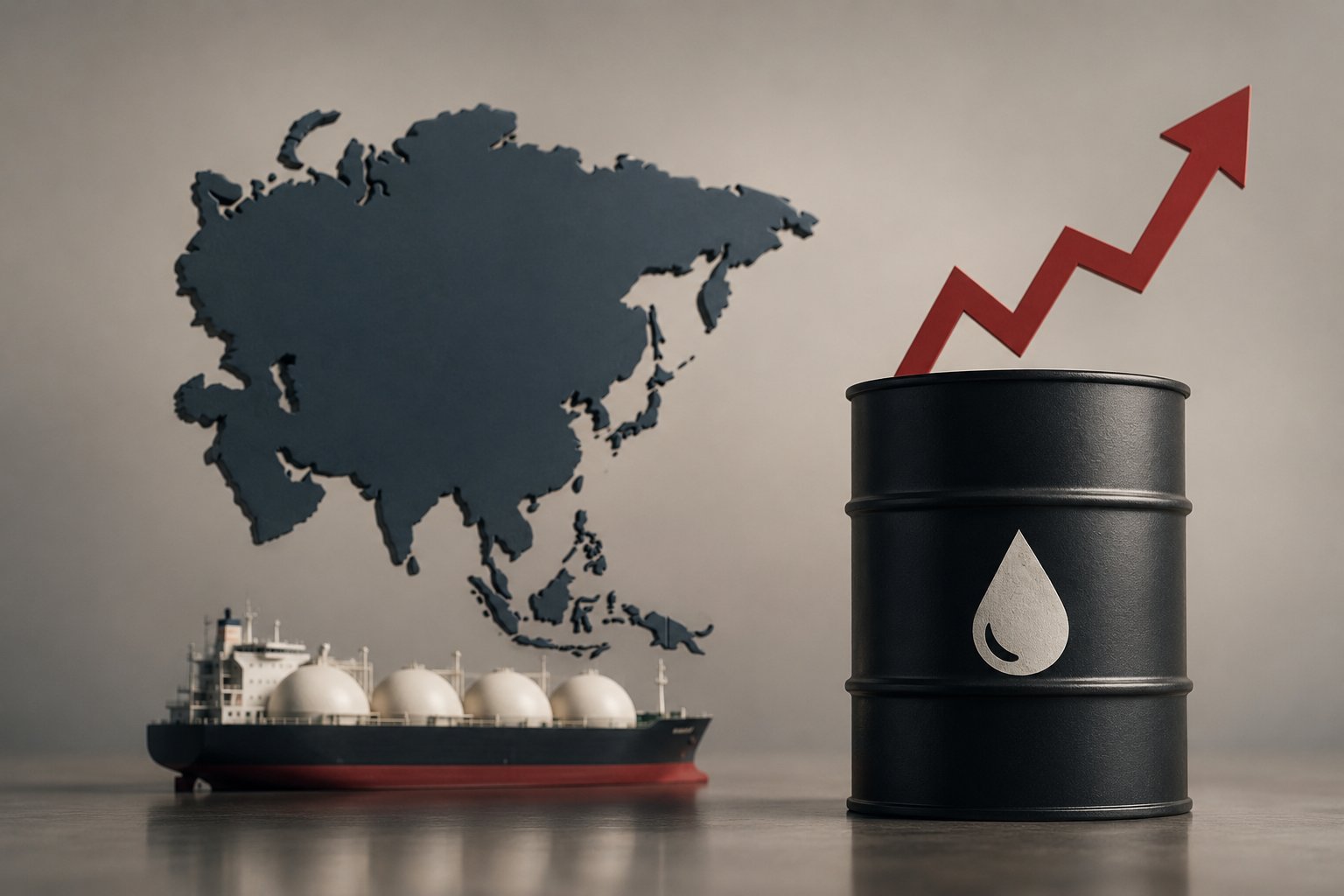
Three weeks ago, a barrel of Brent crude cost $70.50. Today it costs $113.52, per ICE/Trading Economics data as of March 23. That is a 60% increase in the single most important input cost for every economy in Asia. In less than a month.
I want to be direct with you, because the commentary I am reading on this crisis is not direct enough. Most analysis treats the Iran war as a Middle Eastern problem with global spillovers. For Asia, that framing misses the point entirely. Asia imports more oil through the Strait of Hormuz than any other region. Asia receives more LNG from Qatar than any other region. Asia has more citizens working in the Gulf than any other region. And Asia's semiconductor industry depends on a gas called helium that comes, in disproportionate measure, from Qatar.
When the Strait of Hormuz effectively closed in early March, it did not close for the Middle East. Gulf producers simply stopped exporting. It closed for Asia. And the consequences of that closure are likely to reshape business strategy, talent flows, and corporate planning across this continent for years. Possibly a decade.
I have spent twenty years placing and advising senior leaders across borders, through the 2008 financial crisis, through COVID, through the Russia-Ukraine energy shock that rewired European markets. I run an executive search firm, so I should be transparent: I have commercial skin in the talent and leadership dimensions of this analysis. But this moment feels categorically different across every dimension, not just talent. I want to be precise about why rather than relying on instinct alone. Let me walk through what the data actually shows, where genuine uncertainty remains, and what the leaders I speak with every week are doing about it. And what they are not doing that they should be.
The IEA has called this the greatest global energy security challenge in history. The numbers support that characterization. According to Kpler and TankerTrackers data, roughly 20 million barrels of crude oil transited the Strait of Hormuz daily before February 28. Since Iranian forces declared the Strait functionally closed through a combination of missile attacks, drone strikes on Gulf infrastructure, and navigation interference, that flow has collapsed by an estimated 70 to 90 percent. This is the largest supply disruption in the history of the global oil market.
Here is the number that should concern every business leader in Asia. Approximately 80% of Qatar's LNG exports go to Asian buyers, according to IEA trade flow data. Japan, South Korea, China, and India each depend on Qatari gas for between 17% and 33% of their LNG imports. When Iranian drones struck Qatar's Ras Laffan facility on March 2, they knocked out what QatarEnergy's CEO Saad al-Kaabi estimated at 17% of the country's LNG export capacity. Damage he said could take three to five years to fully repair. That shock was absorbed overwhelmingly by Asian buyers. European TTF gas prices roughly doubled, crossing €60/MWh. Asian spot LNG prices rose between 39 and 60 percent, per Bloomberg and S&P Global Platts.
Now consider the structural asymmetry. Europe learned from the Russia-Ukraine crisis. It built eleven new LNG terminals, diversified its supplier base, and cut Russian gas dependency from 45% to 12%. Asia, which had been receiving cheap, reliable Qatari LNG for decades, had no equivalent contingency infrastructure. That assumption of reliability has been destroyed in three weeks.
The compound effects vary by country, but the pattern is consistent across the continent.
India, with thinner strategic reserves than China and heavy reliance on Middle Eastern crude, is taking the full force. Goldman Sachs warned that India's growth story faces what it called a "new broadside," with higher energy costs, slower exports, and weaker remittance inflows converging simultaneously. India's benchmark stock indices declined approximately 10% in the month following the war's outbreak.
The Philippines may be experiencing the sharpest pain of any Asian economy. Diesel prices there have risen 38.6% since the war began, according to local energy department data. The peso dropped to a record low of 60.1 per US dollar on March 19. In response, several Philippine government agencies implemented a four-day work week to reduce electricity costs. That single policy decision tells you more about the severity of this crisis than any analyst report could.
South Korea faces a different but equally alarming exposure, which I will address separately below.
China is better positioned than most. It has enormous strategic reserves, a diversified supplier base, and massive domestic renewable and nuclear capacity. But even China cannot fully insulate itself. The World Economic Forum noted that higher energy costs feed directly into production costs for steel, chemicals, and electronics, squeezing margins and weakening export competitiveness at precisely the moment of intense trade friction with Washington.
The underlying point is structural, not cyclical. Asia's energy exposure is a function of geography. The continent sits at the receiving end of the world's most critical energy chokepoint, and that chokepoint has been shut down while a second one (the Red Sea, still compromised by Houthi disruptions) remains impaired. Two of the three maritime arteries that keep Asia's industrial economy running are simultaneously compromised. I have not been able to find a modern historical precedent for that configuration. And I have looked.
This part of the story is receiving insufficient attention relative to its potential severity for Asia. And for two billion people across South and Southeast Asia, it may end up mattering more than the oil price.
According to industry and UN FAO data, nearly half of the world's traded urea, the most widely used nitrogen fertilizer, is exported from Gulf countries via the Strait of Hormuz. Qatar Fertiliser Company (QAFCO) alone supplies an estimated 14% of the world's urea. When Qatar shut down gas output, the fertilizer supply chain shattered downstream. India cut output from three of its own urea plants. Bangladesh shut four out of its five fertilizer factories. Urea export prices from the Middle East surged approximately 40%, rising from just under $500 to over $700 per metric tonne, according to commodity traders cited in Reuters reporting.
The timing magnifies the damage enormously. We are in the middle of the Northern Hemisphere's sowing season, which runs from mid-February to early May. Fertilizer shortages during planting season cause irreversible yield reductions for the entire growing year. Once the planting window closes, the damage cannot be retroactively corrected. India sources more than 40% of its urea and phosphate fertilizers from the Middle East, per trade data. Even Brazil, the world's agricultural powerhouse, is scrambling for alternatives because nearly half of its fertilizer imports transit the Strait. That means Asian buyers are now competing against Latin American buyers for a shrinking pool of non-Gulf supply.
For corporate leaders operating in South and Southeast Asian consumer markets, the implication is direct but carries genuine uncertainty about magnitude. Consumer purchasing power in these economies is likely to be compressed from two directions simultaneously: higher fuel costs and higher food costs. How severe that compression becomes depends on the duration of the Strait closure, which nobody can predict with confidence. What can be said with confidence is that the pre-February 28 demand assumptions embedded in most 2026 business plans for these markets were set under conditions that no longer exist.
Before the Iran war, the global supply chain was finally healing. After three years of COVID-induced chaos, freight rates had normalized, inventory buffers were being rebuilt, and logistics managers across Asia were cautiously declaring the crisis over.
That declaration lasted exactly until February 28.
According to the International Maritime Organization, over 3,000 vessels are now stranded in the Middle East. War-risk insurance premiums for the Strait of Hormuz surged to approximately 5% of hull value, a roughly 500% increase from pre-conflict levels, per Bloomberg and Reuters reporting. Many insurers withdrew coverage entirely. Drewry data shows container shipping rates on the Shanghai-to-Rotterdam route jumped 19% in a single week. Freightos reported air freight from South Asia to Europe rose 70%.
What makes this categorically different from the COVID shipping crisis is the nature of the constraint. In 2021, too many goods were chasing too few ships and port slots. That was a problem solvable with time and money. In 2026, the origin point for 20% of global oil simply cannot ship. You cannot reroute a Gulf oil terminal around the Cape of Good Hope. Saudi Arabia, Kuwait, Iraq, and the UAE have had to suspend shipments of what Al Jazeera reported as 140 million barrels of oil because the water between them and the world is a war zone.
The just-in-time model that Asian manufacturers perfected over four decades requires two things: predictable transit times and stable shipping costs. Both are now compromised across two of the three major maritime corridors connecting Asia to Europe and the Americas. The companies that built redundancy into their supply chains after 2022, through dual-sourcing critical inputs, maintaining inventory buffers, and diversifying manufacturing footprints, are structurally better positioned. The ones that optimized purely for cost efficiency are discovering that efficiency without resilience is fragility with a better name.
This is the data point that stopped me cold when I first encountered it.
According to the US Geological Survey, Qatar supplies roughly a third of the world's helium. Helium is irreplaceable in semiconductor manufacturing. It is used to cool wafers during etching and in photolithography. Phil Kornbluth, president of Kornbluth Helium Consulting and one of the industry's foremost experts, estimates that more than 25% of global helium supply would be taken off the market by an extended Hormuz shutdown. Under current processes, there is no viable substitute.
Fitch Ratings reports that South Korea, home to Samsung and SK Hynix (the world's two largest memory chip makers), imports about 65% of its helium from Qatar. Kornbluth estimated a minimum two-to-three-month production shutdown and four-to-six months before the helium supply chain returns to normal.
The downstream effects are already materializing. DRAM and HBM chip prices nearly doubled in the first quarter of 2026 compared to the prior quarter, according to industry pricing data. Micron called the bottleneck "unprecedented." Intel stated there was no relief "until 2028." HP, Dell, Lenovo, Acer, and ASUS have warned enterprise clients of 15 to 20% price hikes for the second half of 2026.
TSMC, which produces approximately 90% of the world's most advanced logic chips, faces indirect but significant supply chain exposure. Any sustained disruption to TSMC's helium supply threatens what analysts estimate at roughly $650 billion in planned global AI infrastructure investment. The AI buildout thesis is not dead. But it may be delayed two to three years by a supply constraint that originated in a completely different domain than anyone was watching.
The irony is painful. The world spent three years worrying about Taiwan Strait risk to semiconductor production. The actual disruption came through Qatari helium transiting the Strait of Hormuz. The crisis you prepare for is never the crisis that arrives. The relevant question for boards and leadership teams is not whether you identified this specific risk. You almost certainly did not. The question is whether your organization has the structural capacity to respond to risks you never saw coming.
Europe is experiencing its second major energy shock in four years. The first, triggered by Russia's invasion of Ukraine, forced a €300 billion rebuild of the continent's energy supply architecture. That investment succeeded in cutting Russian gas dependency from 45% to 12%. Then the Iran war knocked out the Qatari LNG that was supposed to replace Russian supply. European gas storage entered March 2026 at just 30% capacity, the lowest pre-injection level since 2022, according to Gas Storage Europe emergency data.
The ECB has explicitly warned of stagflation and potential recession in Germany and Italy. Chemical and steel manufacturers have imposed surcharges of up to 30%, according to industry reporting. BASF is accelerating capacity shifts to the United States and China. The phrase "permanent deindustrialization" is appearing in serious economic assessments, not tabloid headlines.
Why should Asian leaders care? Because European industrial decline creates both risk and opportunity. The risk is reduced European demand for Asian intermediate goods. The opportunity, and it is a substantial one, is that European industrial capacity is migrating. Some of it will migrate to the United States. Some will migrate to Asia. India, Vietnam, Indonesia, and Thailand are the natural candidates. The governments and business leaders who position their economies as destinations for European industrial reallocation in the next 24 months may capture structural gains that persist for decades. This is not speculative. BASF is already executing this shift. The question is who else follows, and where.
Thirty-five million expatriates live in the Gulf countries. Of those, 9.1 million are from India, nearly double the 4.9 million Pakistanis who rank second, per Gulf Labour Markets and Migration programme data. The Indian Gulf diaspora sends approximately $50 billion in annual remittances, representing nearly 38% of India's total remittance inflows. To put that in perspective: it is comparable to India's entire trade surplus with the United States. OFW remittances comprised 7.5% of Philippine GDP in 2024, with the vast majority going directly to food and household expenses, per Philippine central bank data.
Goldman Sachs models a 30 to 35 percent remittance decline under a prolonged crisis scenario. If that materializes, it is not an abstraction for South and Southeast Asian economies. It is a food security event for millions of households that depend on monthly transfers from a family member in Dubai or Doha.
But the same disruption creates an opposing force. The Gulf, and particularly Dubai, had become the world's premier concentration of globally experienced, cross-culturally fluent senior professionals. By early March, security firms reported that major finance and consulting companies were seeking to evacuate between 1,000 and 3,000 employees each, per Reuters. Bloomberg drew a direct comparison to Hong Kong's COVID-era talent exodus, noting how quickly capital and skilled professionals retreat when stability erodes. Analysts at the Middle East Council on Global Affairs described the war as having "irreversibly shaken" the region's image as a safe destination.
Where does that talent go? Early signals point to Singapore and Hong Kong absorbing the financial services and technology talent. Mumbai, Bangalore, and Jakarta will absorb returning nationals. Riyadh is pressing its case, though it sits in the same volatile neighborhood. The structural point is this: the Gulf hub model, which took a generation to build and anchored regional operating models for hundreds of multinationals, is being stress-tested in a way it has never been before. The executives currently reconsidering their location are not making temporary decisions. They are making decade-long commitments about where to raise children and build careers. Those decisions, once made, are sticky. The companies and cities that attract this talent now will compound the advantage for years.
I said earlier that this feels categorically different. Let me make that case precisely, because vague claims of exceptionalism help nobody.
The 2008 financial crisis was a credit shock. Banks froze. Lending stopped. The mechanism of transmission was the financial system, and the solution, massive monetary and fiscal intervention, was architecturally available even if politically painful. The global economy lost approximately 3 to 4% of GDP and recovered to trend within three years.
The 2020 COVID shock was a demand shock. Economic activity stopped because people stopped moving. The solution, vaccines plus fiscal stimulus, was again architecturally available. Recovery was uneven but directionally clear. Most industries returned to pre-pandemic output within two to three years.
The 2026 crisis is a supply shock hitting multiple input channels simultaneously: energy supply, food input supply through fertilizer, shipping route capacity, critical industrial materials like helium and aluminum and sulfur, and the financial stability of the nations most exposed to these supply chains. No prior crisis in the modern era attacked all five simultaneously. The 2022 Russia-Ukraine shock came closest, but it disrupted primarily one energy corridor and one grain corridor. This one disrupts two energy corridors, the fertilizer supply chain, and a semiconductor input that nobody had on their risk map.
Supply shocks are harder to resolve than demand or credit shocks for a simple reason. The solution requires physical infrastructure: repaired LNG terminals, reopened shipping lanes, restored production capacity. You cannot fix this with a policy decision or a rate cut. The QatarEnergy CEO's three-to-five-year repair timeline for Ras Laffan is the relevant benchmark for understanding duration. Even if a ceasefire happens tomorrow, the physical infrastructure damage ensures elevated costs for years.
I want to be honest about what I do not know. I do not know how long the Strait of Hormuz remains closed. I do not know whether the conflict escalates further. I do not know whether a diplomatic resolution emerges in weeks or months. These unknowns are the most consequential variables for every projection in this article. What I do know is that the structural damage already inflicted, to Qatar's LNG capacity, to Gulf shipping infrastructure, to the insurance and risk architecture that enables maritime trade, does not reverse when fighting stops. It reverses when things get rebuilt. And rebuilding takes years.
Generic counsel to "diversify" and "build resilience" is useless if you cannot translate it into decisions your team can execute this week. Here are five specific actions I would urge any CEO or CFO in Asia to take immediately, based on conversations with leaders who are already moving.
One: Remodel your 2026 operating plan around $95 to $110 Brent as your base case, not your stress case. United Airlines CEO Scott Kirby is modeling $175 per barrel as his planning ceiling. You do not need to go that far, but if your 2026 budget assumes $75 oil, you are operating on fiction. Have your finance team run three scenarios at $95, $110, and $130. Present the margin impact, cash burn rate, and covenant implications of each to your board within two weeks. Not as an academic exercise. As the basis for actual operating decisions on headcount, capex, and pricing.
Two: Audit your helium and specialty gas exposure by next Friday. If you operate in semiconductors, electronics manufacturing, medical devices, or fiber optics, your procurement team should be mapping every helium-dependent process in your supply chain, identifying your current supplier's Qatar exposure, and pricing alternative contracts from US and Algerian sources. Today. Kornbluth's four-to-six-month recovery estimate is the optimistic case. If you wait until your current supply contract fails to trigger this analysis, you are already too late.
Three: Convene a board-level review of your Gulf talent concentration within 30 days. If more than two members of your regional leadership team are based in Dubai, Abu Dhabi, or Doha, you need named succession alternatives in geographically diversified locations. Not as a theoretical exercise in a binder, but as executable transfers with visa paperwork initiated, housing identified, and decision rights documented. The specific question for your CHRO: if the Dubai office becomes inaccessible for 90 days, which decisions stop being made?
Four: Lock in fertilizer and agricultural input contracts now if you operate in food, FMCG, or agricultural supply chains. Urea is at $700 per tonne and rising. The sowing season does not wait for geopolitical resolution. If your products depend on agricultural inputs sourced from South or Southeast Asian farms, the yield reductions from this planting season will hit your supply chain in Q3 and Q4. Talk to your procurement team about forward contracts on fertilizer-dependent commodities before the next price leg up.
Five: Start recruiting from the Gulf talent displacement. Actively. This week. I run a search firm, so weight this one accordingly. But the underlying math holds regardless of who benefits commercially: the globally experienced senior professionals currently reconsidering their Dubai-based careers will not be available on these terms for long. If you need a regional CFO, a supply chain VP, or a country general manager with cross-cultural fluency and crisis management experience, the richest talent pool in a decade is in motion right now. The organizations that reach out first will have first selection. The ones that wait for "stability" will find the best candidates already placed.
In the last four years, businesses operating in Asia have absorbed a pandemic that shut down every economy on the continent, a European war that rewired global energy markets, an inflation crisis that compressed consumer purchasing power across emerging markets, an AI revolution restructuring every knowledge-economy job, ongoing US-China trade fragmentation splitting supply chains along geopolitical lines, and now a Middle Eastern war that has simultaneously closed the Strait of Hormuz, crippled the semiconductor supply chain through a helium shortage nobody anticipated, displaced the Gulf talent hub that anchored regional operating models for a generation, and triggered a fertilizer crisis threatening the food security of two billion people across South and Southeast Asia.
Each of these was modeled as a tail risk. All of them happened. Several are happening concurrently.
The question is not whether your organization can survive another disruption. It is whether your organization was designed, in its talent depth, its geographic redundancy, its decision-making speed, and its capital reserves, to absorb multiple simultaneous disruptions that were never modeled as occurring together.
Because if you have not stress-tested that capacity under real conditions, not in a tabletop exercise but against the compounding reality of the last four years, you are not managing risk.
You are discovering it. In public.